


The labor efficiency ratio (LER) compares your adjusted gross profit to your total labor costs. For most service-based businesses, an LER above 2, where labor costs are no more than half of gross profit, tends to produce a profitable business. Getting an accurate number depends on adjusting gross profit for direct labor and counting every people cost.
It’s a number our CFOs pay close attention to across all of our clients, because it says a lot about whether a business can operate profitably. Greg Crabtree popularized the concept in Simple Numbers, Straight Talk, Big Profits!, and we’ve adapted how we calculate it to fit the service businesses we work with.

What Is a Good Labor Efficiency Ratio?
For most service-based businesses, a labor efficiency ratio above 2 tends to produce a healthy, profitable business. At that level, total labor costs are half of gross profit or less.
We treat 2 as a baseline rather than a fixed rule. Some industries call for a higher ratio, and e-commerce companies, for example, often need more room. Others can stay profitable at a lower one.
A strong LER usually goes along with profitability, but it doesn’t guarantee it. Gross profit still has to cover labor, operating expenses, and profit, so the ratio is one important signal rather than the whole picture.
How Do You Calculate Your Labor Efficiency Ratio?
To calculate your labor efficiency ratio, divide adjusted gross profit by total labor costs. The formula is simple. The inputs are where most calculations go wrong.
It’s tempting to take gross profit and total payroll straight from your P&L and divide. Sometimes that produces a false positive: a ratio that looks great for a business that is struggling. We often talk with owners who have unprofitable months and little cash in the bank, and who can’t understand why when their LER looks healthy. Getting the two inputs right is what keeps the ratio honest.
Start With Adjusted Gross Profit
Gross profit is revenue minus cost of goods sold (COGS), also called direct costs. If your P&L separates revenue from direct costs, you already have a gross profit number, which is a good start.
The adjustment comes from direct labor. We often see labor included in COGS in one of two ways:
- W-2 wages allocated to direct costs. A marketing agency, for example, might put the wages of team members working on client projects into COGS and leave everyone else in operating expenses.
- Subcontractors doing the work. This is common in construction and the trades. A company might sell a painting job, then subcontract it to another painting company that actually produces the revenue.
In either case, move that direct labor out of COGS and into labor costs. COGS minus direct labor gives you adjusted COGS, and revenue minus adjusted COGS gives you adjusted gross profit. This adjustment is for the LER calculation only. It doesn’t require changing how those costs are recorded in your books.
Which Costs Count as Labor?
Total labor costs include everything associated with having an employee:
- W-2 wages, including the direct labor you moved out of COGS
- Payroll taxes
- Retirement contributions, such as a 401(k)
- Health care
- Other employee benefits
- Bonuses and commissions
We also include subcontractors when they directly perform your services.
Which Costs to Leave Out
Outsourced services that support the business, rather than produce its revenue, stay out of labor costs. These are general and administrative expenses, such as:
- A cleaning company for your office
- An outsourced bookkeeper or CPA
- An IT consultant
- An attorney you consult occasionally

Want to run your own numbers? Our free Labor Efficiency Ratio Calculator is a simple spreadsheet you can download and adjust to fit your business.
What Does an LER Look Like in Practice?
Here’s a simplified example with hypothetical, round numbers. Picture a materials-heavy business, such as a fabrication company or a trade, with $2 million in revenue and $1.2 million in COGS. Of that COGS, $700,000 is direct labor. Moving it out leaves $500,000 in adjusted COGS and $1.5 million in adjusted gross profit.
Labor costs include that $700,000 of direct labor, plus $500,000 for the CEO, admin staff, and others who help run the business. Payroll taxes add $110,000, health care adds $75,000, retirement contributions add $40,000, other benefits add $30,000, and bonuses and commissions add $100,000. That brings total labor costs to $1,555,000.
Here’s how the same costs look at two revenue levels:
| $2M revenue | $3M revenue | |
| Adjusted gross profit | $1,500,000 | $2,500,000 |
| Labor efficiency ratio | About 0.96 | About 1.6 |
| Left for operating expenses and profit | Less than zero | About $945,000 |
At $2 million, the LER is about 0.96. Labor costs are higher than gross profit, so the business is losing money before it pays a single operating expense. At $3 million in revenue with the same costs, the ratio climbs to about 1.6, leaving roughly $945,000 for everything else.

That leftover amount is why the ratio matters. In a service business, gross profit has to pay your people first. What’s left covers operating expenses like rent, your bookkeeper, IT support, and marketing, and then profit. Profit has its own work to do, and we walk through the jobs profit has to do in a separate guide.
Want help looking at your own numbers? Schedule a Discovery Call and we’ll walk through your labor efficiency ratio with you.
How Can You Improve a Low LER?
When the ratio comes in low, we look at a few levers, often in this order.
Revisit Your Pricing
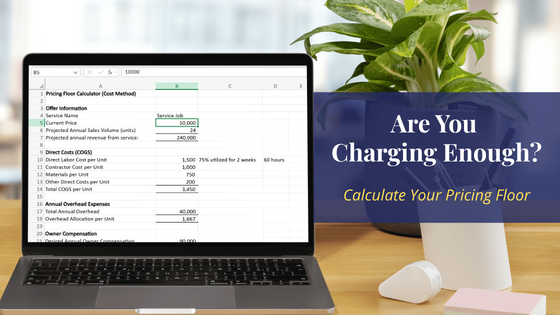
In the $2 million example, the deeper issue is that the work was never priced appropriately to begin with. Losing money before operating expenses can point to a pricing problem. A 20% price increase would improve the ratio without fully fixing it, so it might take more than one increase over time to reach a healthy level. Finding your pricing floor can help you check whether your prices cover your costs.
Look for Efficiency in Labor and Overhead
Alongside pricing, look for efficiency gains. That can mean reviewing direct labor, taking a closer look at administrative staffing, and reducing operating expenses where you can.
Run Lean When Pricing Can’t Move
Sometimes prices can’t go much higher and the ratio can’t realistically reach 2. In that case, keeping operating expenses lean matters even more, so the business can put what it needs into its people and still make a profit.
A few questions can help you decide where to start:
- Is your LER below 1? Labor costs exceed adjusted gross profit, so review your pricing and labor costs to see what’s driving the gap.
- Has a price increase helped without getting you to 2? Consider another increase, and review labor and overhead for efficiency.
- Can’t raise prices or reach 2? Make lean operating expenses the priority.
How a Fractional CFO Uses Your Labor Efficiency Ratio
Calculating your LER shows you where the pressure is. Making the changes it points to, like raising prices, adjusting staffing, or cutting overhead, is often the harder part.
Our CFOs pay attention to labor efficiency across all of our clients. We calculate the ratio with the adjustments above, working alongside your accounting team, then help you evaluate the options and determine the right next steps for your business. If the math makes sense but the next steps feel big, our fractional CFO services are built for that kind of work.
Key Takeaways
- The labor efficiency ratio compares adjusted gross profit to total labor costs.
- For most service-based businesses, an LER above 2 tends to produce a profitable business, though some industries need a higher or lower target.
- Move direct labor out of COGS and count every people cost, including payroll taxes, benefits, and subcontractors who directly perform your services.
- When the ratio is low, look at pricing first, then labor efficiency and operating expenses. You can run your own numbers with our free LER calculator.
Frequently Asked Questions
Should subcontractors be included in the labor efficiency ratio?
Yes, when they directly perform the services you sell. A trades company that subcontracts a painting job, for example, should count that cost as labor. Outsourced services that support the business instead, like an office cleaning company, an outsourced bookkeeper or CPA, IT help, or legal advice, are general and administrative expenses and stay out of the calculation.
Does a good labor efficiency ratio mean my business is profitable?
Not automatically. A ratio above 2 tends to go along with profitability in most service-based businesses, but gross profit still has to cover operating expenses like rent, marketing, and administrative support. A ratio can also look better than it is if direct labor is left in cost of goods sold or some people costs are missing from the calculation.
How is a fractional CFO different from a bookkeeper or accountant?
Bookkeepers and accountants typically maintain accurate records, prepare financial statements, and report on results. A fractional CFO focuses on forward-looking strategy, like cash flow planning, forecasting, and helping leadership make informed decisions. We work alongside your accounting team rather than replacing it.
Can a fractional CFO help improve our labor efficiency ratio?
Yes. We calculate the ratio with the adjustments described above, then look at what’s driving it. Depending on what we find, that could mean reviewing pricing, looking for efficiency in labor or administrative staffing, or keeping operating expenses lean. The goal is a business that can invest in its people and still have enough left for operating expenses and profit.
For more answers, visit our full FAQ page.