
You can improve your invoicing process, collect deposits, stay on top of accounts receivable, and pay closer attention to utilization. But if cash flow is still consistently tight, there may be a more fundamental issue to look at.
Your pricing.
If you don’t charge enough to cover your service costs and business expenses, better cash flow habits can only help you so much.
If cash flow is part of the challenge, you can also explore our guide on 5 Cash Flow Habits Every Healthy Service Business Practices to look at the other financial habits that may be affecting your cash position.
That is where a pricing floor can help.
Your pricing floor is the minimum sustainable amount you need to charge for a service. It accounts for the direct cost of delivering the work, your overhead, owner compensation, and the profit you want the company to generate.
It is not necessarily what you should charge; your final price may be higher based on your market, positioning, customers, and other factors.
But before deciding how high your price can go, it helps to know how low it can realistically be.

What Is a Pricing Floor?
Pricing involves more than a formula.
There is still the market to consider. Your positioning matters. So does your customer, your environment, and what buyers are actually willing to pay.
A pricing floor gives you a different piece of the puzzle.
Rather than answering, “What should we charge?” it helps answer:
“What is the minimum we need to charge for this service for the financials to work?”
That number can give you a useful starting point when reviewing your current pricing.
If your service consistently sells for less than its pricing floor, there may not be enough revenue left to cover everything the company is expected to support.
What Actually Goes Into the Cost of a Service?
One of the easiest mistakes to make with service pricing is focusing only on the obvious cost of doing the work.
You may already be tracking how many hours an employee spends on a client or how much you pay a contractor for each project.
Those costs matter, but they are only part of the picture.
Direct Costs
Direct costs are the expenses tied directly to delivering a particular service or project.
Depending on your company, those might include:
- Employee labor spent serving the client
- Contractor payments
- Materials or supplies
- Preparation time
- Revisions included in the scope
- Payment processing fees
- Project management tied directly to the work
- Software that costs more each time you add a client
- Other expenses incurred specifically because the project exists
You may see these expenses called cost of goods sold, cost of sales, or cost of service.
For this purpose, the terminology matters less than making sure the costs are being captured.
For example, if adding a new client requires an additional software subscription, that expense belongs in the cost of serving that client. If a software platform supports the entire company, no matter how many clients you serve, it’s likely an overhead cost.
Overhead Costs
Overhead includes the expenses required to operate the company that cannot be cleanly tied to one individual client.
That can include:
- Administrative staff
- General software subscriptions
- Marketing and advertising
- Insurance
- Rent
- Office expenses
- Nonbillable team time
- Sales and business development
- Owner oversight
- Other operating expenses
These expenses still have to be paid even though there may not be a neat line connecting each one to a client project.
Your pricing has to leave enough room for them, too.
Don’t Leave Owner Compensation Out of Your Pricing
Owner compensation is one of the easiest pieces to overlook, particularly in smaller service businesses.
If you are doing a significant amount of client work yourself, it can be tempting to treat that labor as free.
It is not.
One useful way to look at owner-delivered work is to consider what it would cost to hire someone else to perform it.
Owner compensation also matters beyond direct client work.
You may already receive a W-2 salary. You may take distributions in addition to that salary. Or you may operate under a structure where your compensation comes out of the company differently.
The exact setup can vary.
When calculating pricing, look at what the owner needs to earn, not relying on what they have been paid in the past.
If past compensation has been too low, the service can look more profitable than it actually is.
Pricing should account for appropriate owner compensation.
If you are wondering what should happen to profit after the company generates it, read our blog on What to Do With Business Profit: 5 Jobs Every Dollar Has for a closer look at the different jobs profit may need to support.
Gross Margin Is Only Part of the Pricing Picture
Gross margin is an important number, but it does not tell you everything about whether your pricing works.
The basic calculation is:
Revenue – Cost of Goods Sold = Gross Margin
For many service-based businesses, a gross margin around 60% or higher can be a useful target when all direct labor is included in cost of goods sold.
But that is not a universal rule.
A company with very low overhead may still produce strong overall profit at a lower gross margin. Another company may need more room at the gross-margin level because it has more operating costs to support.
The bigger goal is what remains after all the expenses are paid.
A roughly 20% overall profit margin is another target we look toward for service-based businesses, but again, the right number depends on the company and its cost structure.
This is also why simple markup shortcuts can be misleading.
For example, taking your labor cost and multiplying it by two may appear to give you plenty of margin. But that calculation may still leave out contractors, materials, overhead, owner compensation, and your desired profit.
A healthy-looking markup on one cost does not automatically mean the final price supports the entire company.
Calculate Your Pricing Floor
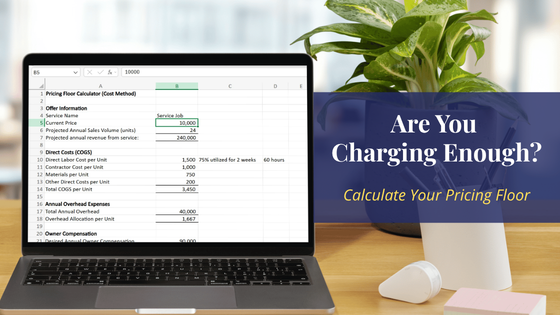
If you are not sure if your current pricing accounts for all these costs, our free Pricing Floor Calculator can help you work through the numbers.
Use it to estimate the direct costs, overhead, owner compensation, and profit that your pricing needs to support.
How to Calculate Your Pricing Floor
The calculator works by bringing several pieces of your pricing together.
- Estimate how many services or projects you can realistically deliver. Start with the number of units you expect to sell during the year. Depending on the company, one unit could be a project, engagement, client package, or another repeatable service.
- Calculate the direct cost of each service. Include the labor, contractors, materials, and other costs directly associated with delivering the work.
- Allocate your annual overhead. Look at the operating expenses required to run the company and determine how much needs to be supported by each unit you expect to sell.
A forward-looking budget can be particularly helpful here because your costs in the coming year may not look exactly like last year’s costs.
- Include desired owner compensation. If appropriate owner compensation has not already been captured elsewhere in your calculation, include the amount the company needs to support.
- Account for profit. After covering the costs of delivering the work, overhead, and owner compensation, determine what profit target you want the pricing to support.
Together, these pieces give you a better estimate of the minimum sustainable price for the service.
What a Pricing Floor Can Reveal
Consider a simplified example of a small painting company.
The numbers below are hypothetical and are meant only to illustrate the calculation.
Pricing Component | Example |
|---|---|
Current project price |
$10,000 |
Expected projects per year |
24 |
Direct cost per project |
$3,450 |
Annual overhead |
$50,000 |
Desired owner compensation |
$100,000 |
Profit target |
20% |
Calculated minimum sustainable price |
$12,125 |
At first glance, a $10,000 project may sound like a reasonable amount.
The direct cost is only $3,450, so there appears to be plenty of room between the cost of performing the work and the selling price.
But once the company accounts for overhead, owner compensation, and profit, the picture changes.
In this example, the minimum sustainable price comes out to $12,125.
That does not mean painting companies should charge $12,125 per project. The point is that a price can look profitable based on direct costs alone and still fall short once the full cost of running the business is included.
Changing assumptions around overhead, owner compensation, or profit will also change the pricing floor. That is why the calculator is meant to help you test your own numbers rather than apply one fixed formula to every business.
What If Your Current Price Is Below Your Pricing Floor?
If your calculation shows that your current price sits below the floor, it gives you a reason to look more closely at the assumptions behind the numbers.
Some useful questions to ask include:
- What are we currently spending on overhead?
- Are all of our direct service costs included?
- How much owner compensation are we asking the company to support?
- What profit target are we building into the price?
- How many projects or units can we realistically deliver each year?
- Does changing any of those assumptions change the minimum sustainable price?
The point is not to lower expenses, owner compensation, or profit targets until the calculator produces the price you want.
It is to understand what your current price is actually expected to support.
Sometimes that calculation makes it clear why a company can be busy, continue bringing in revenue, and still struggle to meet the financial goals expected.
Pricing is only one part of the cash flow picture. If you want a more forward-looking view of your cash position, learn the difference between Profit vs Cash Flow and Why a Profitable Business Can Still Run Out of Cash.
If you are deciding how closely you need to monitor cash, you can also compare Weekly vs. Monthly Cash Flow Forecasting to see which approach may make more sense for your situation.
Your Pricing Floor Is the Starting Point, Not the Final Price
The pricing floor gives you a financial minimum.
It does not tell you the maximum amount your service is worth.
Your actual selling price can still depend on your position in the market, your customer, the environment, and what the market will bear.
That means your final price may be well above the floor.
But understanding the floor gives you an important reference point before you make those broader pricing decisions.
If you have been working on cash flow and still feel like there is never quite enough room, it may be worth looking beyond the timing of money coming in and out.
The underlying pricing may be part of the problem.
Key Takeaways
- A pricing floor represents the minimum sustainable price for a service, not necessarily the final amount you should charge.
- Direct service costs are only part of the calculation. Pricing also has to support overhead.
- Owner labor and owner compensation should not be treated as free.
- Gross margin is useful, but it does not tell you whether the entire cost structure works.
- Looking at all of these pieces together can help explain why pricing that appears profitable may still create cash flow and profitability challenges.
Find Your Pricing Floor
If you want to work through your own numbers, download Clara CFO Group’s free Pricing Floor Calculator.
Use it to estimate your direct costs, overhead, owner compensation, profit target, and the minimum sustainable price for your service.
Ready to Put a CFO in the Finance Seat?
Clara CFO Group is a boutique fractional CFO firm serving growth-stage companies generating $2M–$20M in annual revenue. We partner with CEOs who are ready to move beyond reactive financial management and install the financial leadership needed to scale with confidence.
If you want to learn more about what that level of support looks like, explore our fractional CFO services.
Whether you’re running on EOS® and need a CFO who can fully own the finance function, or you’re looking for a strategic partner to guide financial planning, profitability, cash flow, and high-impact decision making, we’re here to help.
Our CFOs become an extension of your leadership team, providing the financial strategy, accountability, and insights needed to build a more profitable, scalable, and valuable business.
Schedule a Discovery Call to learn how Clara CFO Group can help you achieve your next stage of growth.
Ready to Put a CFO in the Finance Seat?
Clara CFO Group is a boutique fractional CFO firm serving growth-stage companies generating $2M–$20M in annual revenue. We partner with CEOs who are ready to move beyond reactive financial management and install the financial leadership needed to scale with confidence.
Whether you’re running on EOS® and need a CFO who can fully own the finance function, or you’re looking for a strategic partner to guide financial planning, profitability, cash flow, and high-impact decision making, we’re here to help.
Our CFOs become an extension of your leadership team, providing the financial strategy, accountability, and insights needed to build a more profitable, scalable, and valuable business.
Schedule a Discovery Call to learn how Clara CFO Group can help you achieve your next stage of growth.
EOS® and related trademarks are the property of EOS Worldwide.