


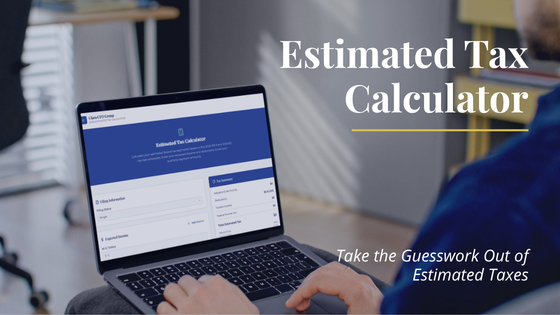
Estimated Tax Calculator: Calculate Your Payments
An estimated tax calculator can make one of the more frustrating parts of running a business easier to manage: figuring out how much to pay in estimated taxes.
Your CPA may give you quarterly payment amounts, and you make those payments on schedule. Then tax time arrives and you discover you paid considerably more than necessary, or not nearly enough.
Neither situation is ideal.
Underpaying can leave you with a larger tax bill than expected. Overpaying may mean sending cash to the IRS that could have stayed available in your business longer.
To calculate your 2026 estimated tax payments, estimate your taxes for the year, account for withholding and payments already made, then compare the result against the applicable payment requirements to see whether more may still be due.
Step 1: Estimate your taxes
Use your expected income, filing status, deductions, and other applicable taxes.
Step 2: Account for what’s already covered
Factor in expected withholding and estimated payments you’ve already made.
Step 3: See what may still need to be paid
Compare those numbers against the required annual payment, including safe harbor rules, to see whether additional estimated payments may be needed.
That is the purpose behind our Estimated Tax Calculator. It helps you work through the information affecting your estimated payments so you can get a clearer idea of what you may still need to pay.

Why Estimated Tax Payments Can Get Off Track
Estimated tax payments are exactly that: estimates.
You may be making the quarterly payments originally calculated for you and still end the year having paid substantially more or less than expected.
That does not mean the original calculation was necessarily wrong. The goal is to have a way to revisit the numbers and see whether your current payments still make sense based on the information available now.
Taxes are also one of the less flexible uses of business profit. You may have more choice around distributions, reinvestment, or reserves, but tax obligations still have to be planned for.
We explain that distinction more in What Should You Do With Business Profit? The 5 Jobs Every Dollar Has to Do.
Recalculating your estimated taxes is not about replacing your CPA or working around your accounting team. It gives you another planning tool for evaluating what you may need to pay during the year.
What Is an Estimated Tax Calculation Actually Telling You?
One of the most important things to understand is that your estimated tax payment requirement is not necessarily the same as your final tax bill.
An estimated tax calculation helps determine whether you are paying enough toward your expected taxes throughout the year.
That is different from preparing your final tax return.
You might have extra tax items or special situations that could change what you owe. An estimated tax calculator helps you assess what you may need to pay throughout the year. It also checks if you are meeting requirements to avoid underpayment penalties.
Think of it as a planning tool rather than a prediction of your final return down to the dollar.
How the Estimated Tax Safe Harbor Fits In
One of the pieces the calculator considers is estimated tax safe harbor.
Generally, the required annual payment is based on the smaller of 90% of your expected current-year tax or 100% of your prior-year tax. For certain higher-income taxpayers, the prior-year threshold increases to 110%.
The calculator also considers expected current-year withholding and any estimated tax payments already made.
Together, those numbers help answer an important question:
Based on the information entered, how much may still need to be paid toward taxes during the year?
That required payment is not necessarily the same as the exact amount you will ultimately owe when your tax return is prepared.
For additional guidance on estimated taxes and Form 1040-ES, see the IRS Form 1040-ES guidance.
What Goes Into the Estimated Tax Calculator?
The quality of any estimated tax calculation depends on the information going into it.
The Estimated Tax Calculator brings several pieces together so you can see how they affect the result.
Income and Filing Information
You can start by entering your filing status and expected income.
The calculator allows you to add multiple income sources rather than assuming everything comes from one place. Changing your filing status also adjusts the standard deduction used in the calculation.
If you plan to use itemized deductions instead, you can enter that amount directly.
Other Tax Information
Depending on your situation, you may also need to account for items such as:
- Self-employment tax
- Other applicable items from Form 1040-ES
- Prior-year tax
- Expected current-year withholding
- Estimated tax payments already made
The calculator considers these pieces together rather than looking only at your business income.
For example, withholding from W-2 wages may already be covering part of the amount required during the year.
What the Calculator Shows You
Once your information is entered, the web app provides more than one final number.
You can see information including:
- Estimated taxable income
- Estimated federal income tax
- Effective tax rate
- Marginal tax rate
- A breakdown of how income falls across the tax brackets
- Required annual payment
- Estimated amount remaining to be paid
The tax-bracket breakdown helps you see the difference between your marginal tax rate and the effective rate across your income.


The Estimated Tax Calculator Is Now Available as a Web App
We originally created the Estimated Tax Calculator as an Excel tool and have updated it each year as tax rate schedules change.
For 2026, both versions of the calculator also include access to a web app.
The Excel version is still available. However, the online interface provides a simpler way to handle calculations. You don’t have to be very skilled with spreadsheets to use it.
The web app uses the current tax rate schedules and presents the calculation in a cleaner format, including the tax-bracket breakdown, effective and marginal tax rates, and estimated payment information.
For Small Business Owners
If you are calculating estimated taxes for your own business, you can access the 2026 Estimated Tax Calculator here:
Get the Estimated Tax Calculator
For Accountants
We also have a separate version for accountants who want to use the calculator across client work.
Get the Accountant Estimated Tax Calculator
Both versions include access to the web app.
Is an Estimated Tax Calculator Enough for Your Situation?
An estimated tax calculator can be a useful planning tool, but it cannot account for every possible tax situation.
A few questions can help you decide how much support you may need:
- Do you have relatively straightforward income, withholding, and estimated payments? The calculator can help you work through those numbers and see whether your current payments appear to be on track.
- Do you have capital gains or other tax items that make your situation more complicated? Use the calculator as an analysis tool, then work through those additional considerations with your accountant.
- Are you unsure what numbers belong in the calculator? That is a good reason to involve your accountant rather than guessing at the inputs.
The calculator is not an IRS form, and it is not a substitute for individualized tax advice.
Tax planning is also only one piece of the broader financial picture. Through our fractional CFO services, we work alongside business owners, bookkeepers, and CPAs to connect financial obligations with cash flow, forecasting, profitability, and the other decisions that affect a growing company.
That broader cash picture matters here too. Paying enough in taxes is important. However, sending too much money out of the business can hurt your flexibility.
Building healthy cash flow habits can help you stay more aware of what is coming in, what is going out, and what your cash position may look like ahead.
Key Takeaways
- Estimated tax payments may need to be revisited as your financial situation changes during the year.
- The amount required for estimated-tax purposes is not necessarily the same as your final tax liability.
- Expected income, deductions, withholding, prior-year tax, and payments already made can all affect what you may still need to pay.
- An estimated tax calculator can make the calculation easier to understand, but more complicated situations may still require help from your accountant.
Ready to run your own numbers? Get the Estimated Tax Calculator. Accountants can access the accountant version here.
Ready to Put a CFO in the Finance Seat?
Clara CFO Group is a boutique fractional CFO firm serving growth-stage companies generating $2M–$20M in annual revenue. We partner with CEOs who are ready to move beyond reactive financial management and install the financial leadership needed to scale with confidence.
Whether you’re running on EOS® and need a CFO who can fully own the finance function, or you’re looking for a strategic partner to guide financial planning, profitability, cash flow, and high-impact decision making, we’re here to help.
Our CFOs become an extension of your leadership team, providing the financial strategy, accountability, and insights needed to build a more profitable, scalable, and valuable business.
Schedule a Discovery Call to learn how Clara CFO Group can help you achieve your next stage of growth.