


As a fractional CFO firm, we talk to a lot of small business owners, and one thing comes up more than almost anything else: frustration with the CPA relationship. Business owners hire a CPA expecting to gain a financial partner, someone who can help them think through big decisions, and then feel let down when that support never quite shows up.
We want to walk through why this happens, because in most cases, it isn’t a sign that your CPA is doing a bad job. It’s usually a sign that the role you’re looking for and the role you actually hired are two different things.
The Root of the Frustration: A Mismatch in Expectations
Here’s a scenario we hear often. A business owner brings on a CPA, feels good about finally having financial expertise on the team, and signs the engagement paperwork without digging too deep into the details. Life gets busy, questions come up, and those questions get sent over to the CPA with the assumption that this is exactly what they signed up to handle.
Sometimes that goes fine. Other times, the CPA either doesn’t respond as quickly as expected or says that the question falls outside what they were engaged to do. That’s usually the moment frustration sets in.
Before assuming the relationship is broken, it’s worth going back to the engagement letter you originally signed. That document spells out exactly what services you agreed to, and it’s often the clearest explanation for why expectations and reality don’t match up.
What Your CPA Engagement Actually Covers
Most CPA engagements are built around tax compliance rather than ongoing business advisory. Depending on what you agreed to, that typically includes:
-
Preparing and filing your tax return
-
Calculating estimated tax payments
-
Filing state returns, if included in the scope
-
Handling certain payroll related tax matters
-
A tax planning conversation, usually limited to once a year
Some CPAs do offer broader advisory services, but those services should be clearly defined and intentionally added to the engagement. Without that, ongoing strategic guidance usually is not part of what you signed up for.
This isn’t a knock on CPAs. The work of preparing accurate returns and staying compliant is valuable and demanding on its own. It just isn’t the same job as helping you decide what to do next.
Why CPA Firms Are Structured This Way
Many tax-focused CPA firms are built around deadlines, compliance, and return preparation. Their model is designed around completing accurate returns within tight timelines, not providing ongoing strategic guidance around hiring, cash flow, or growth.
There are exceptions, of course. Some CPA firms do offer more advisory support, but for many tax-focused firms, the structure is centered on historical financial information.
That makes sense for tax work. When your CPA is preparing a return, they are looking at what already happened. But when you are deciding whether to make a hire, add a new expense, or take the business in a new direction, you need support that looks forward.
Even now, your CPA is likely finishing up last year’s tax return while the current year is already well underway. Their entire frame of reference is historical, which makes sense for compliance work but makes them a less natural fit for a decision that depends on where your business is headed.
The Real Question: Is This a CPA Problem or a Missing Role?
If you’ve felt this friction, the more useful question isn’t “is my CPA falling short,” it’s “am I asking for a service I never actually engaged them to provide.”
In most cases, when business owners go back and reread their engagement letter, they realize the CPA has been doing exactly what was agreed to. The gap isn’t a failing provider; it’s a missing role on the team.
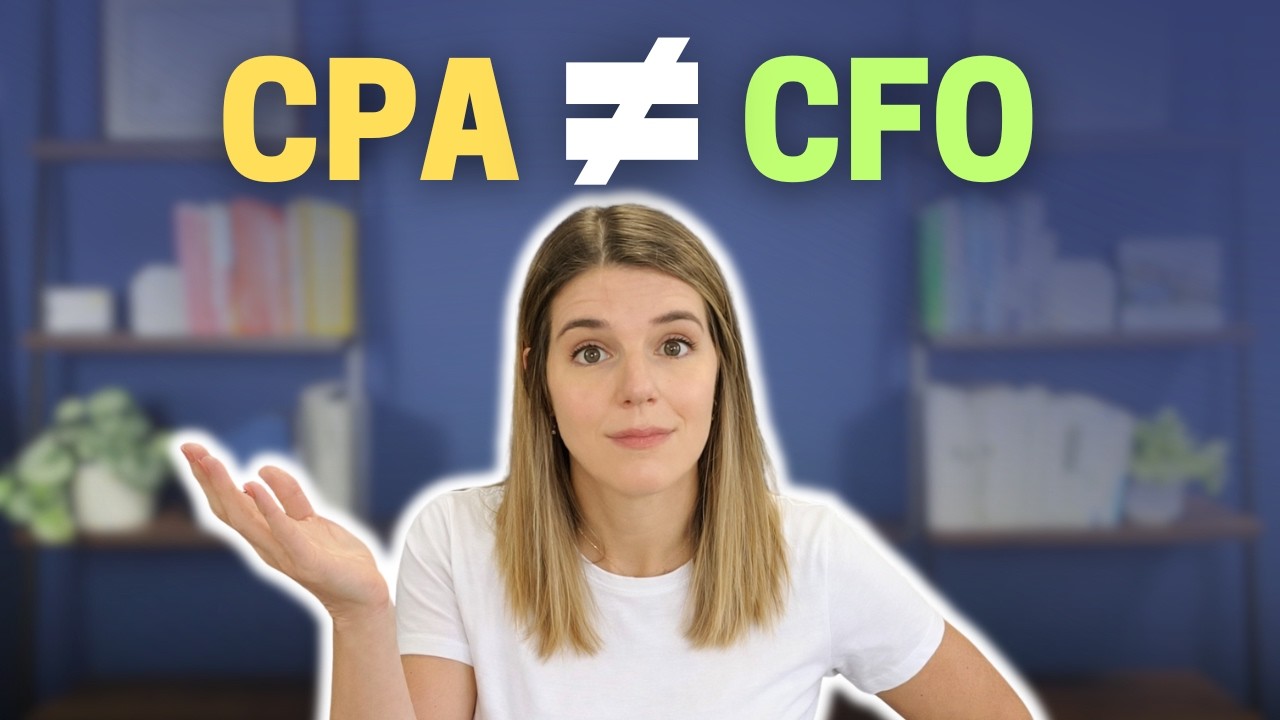
CPA vs CFO: What Each Role Is Built to Do
It helps to think of these as two distinct roles rather than two versions of the same job.
Your CPA helps you stay compliant. Their focus is on tax returns, filing deadlines, and accurate historical reporting.
Your CFO helps you make future-focused decisions. Their focus is on what your numbers mean for growth, hiring, cash flow, profitability, and long-term strategy.
Neither role replaces the other. They’re built to answer different kinds of questions, which is exactly why relying on one to do the other’s job tends to create frustration.
What a Fractional CFO Actually Does Differently
A CFO is built to support the forward-looking financial questions your CPA may not have been engaged to handle.
Questions like:
-
Can we afford to hire this person?
-
Should we open a second service line?
-
Can we take on this new expense right now?
-
What does our cash flow tell us about our next move?
-
Are we actually growing profitably, or just growing?
A CFO works closely with you all the time. They keep a forward-looking forecast and help with hiring, cash flow, and growth. This support happens before decisions are made, not afterward.
This is the kind of support we provide at Clara CFO Group through our Financial Clarity Solution™. This includes financial leadership, forecasting and scenario analysis, decision support, and ongoing cash flow management for growing service-based businesses.
How to Move Forward
If this sounds familiar, it’s worth taking a step back and evaluating what you actually have in place versus what you need. A few questions to ask yourself:
-
Have you actually reviewed your CPA engagement letter recently?
-
Are the questions you’re asking tax questions or business strategy questions?
-
Do you need a once-a-year tax planning conversation or ongoing decision support throughout the year?
-
Do you have a cash flow forecast you’re actively using?
-
Do you have someone helping you interpret financial data before you make a big decision?
-
Have you been expecting your CPA to act like a CFO without ever formally engaging them for that work?
From here, you have two reasonable paths. You can hold your CPA accountable to what’s actually in your engagement letter and ask what it would take to add the services you’re missing. Or, you might see that you need a whole new role. One that focuses on ongoing, forward-looking financial strategy.
It’s also worth noting that adding CFO support doesn’t mean replacing your CPA. At Clara CFO Group, we partner directly with our clients’ bookkeepers and CPAs so that everyone on the financial team is working toward the same goals. We focus exclusively on CFO strategy, which means your CPA can stay focused on compliance while we focus on what the numbers mean for your next move.
Key Takeaways
-
Your CPA may not be failing you; they may simply be doing what they were engaged to do.
-
The engagement letter is the clearest place to confirm what services are actually included.
-
Tax compliance and business advisory are two different jobs, not two versions of the same one.
-
Forward-looking decisions, like hiring, growth, and cash flow planning, usually call for CFO-level support.
-
A strong financial team often includes both a CPA and a CFO, each owning a distinct part of the picture.
Ready for Forward-Looking Financial Support?
If you’re asking questions your CPA was never engaged to answer, it may be time to add CFO-level support to your financial team.
At Clara CFO Group, we provide fractional CFO and outsourced CFO services exclusively for service-based businesses and agencies earning $1M or more. Whether you are running on EOS and need a CFO for EOS who can own the financial side of your business, or you are looking for a trusted financial partner to help you improve profitability, manage cash flow, and make confident decisions, our Financial Clarity Solution is built for exactly that.
We work with founders who are ready to move from reactive financial management to strategic financial leadership.
Book a Discovery Call to learn how Clara CFO Group can support your business.
Ready to Put a CFO in the Finance Seat?
Clara CFO Group is a boutique fractional CFO firm serving growth-stage companies generating $2M–$20M in annual revenue. We partner with CEOs who are ready to move beyond reactive financial management and install the financial leadership needed to scale with confidence.
Whether you’re running on EOS® and need a CFO who can fully own the finance function, or you’re looking for a strategic partner to guide financial planning, profitability, cash flow, and high-impact decision making, we’re here to help.
Our CFOs become an extension of your leadership team, providing the financial strategy, accountability, and insights needed to build a more profitable, scalable, and valuable business.
Schedule a Discovery Call to learn how Clara CFO Group can help you achieve your next stage of growth.
EOS® and related trademarks are the property of EOS Worldwide.