

Fractional CFO ROI: How to Calculate Your Return
Is a Fractional CFO Worth the Investment?
If you’re thinking about hiring a fractional CFO, you’ve probably wondered:
Is it worth it? Will it pay for itself? What do I actually get back?
Those are fair questions, and all business owners should ask them before they invest. The answer comes down to the return on investment (ROI) of a fractional CFO, meaning what you get back compared to what you put in.
A fractional CFO is worth it when the financial value they create is greater than what the service costs. There’s no single number that fits every business, though. Your return depends on your numbers, your needs, and how much room you have to improve.
It also matters that the growth shows up in your profit. If revenue goes up but profit doesn’t, that’s not the return you’re looking for.
How Do You Calculate Fractional CFO ROI?
To put numbers to it, compare what the CFO’s work adds to your business with what you pay for it.
If you spend $50,000 a year on CFO support, you’d want to see more than $50,000 come back in value.
There isn’t one formula that works for everyone. Every business starts in a different place, with its own things to fix and its own opportunities to improve. That’s why it helps to look at your own numbers instead of an industry average.
Estimate Your Potential ROI With the CFO Impact Calculator
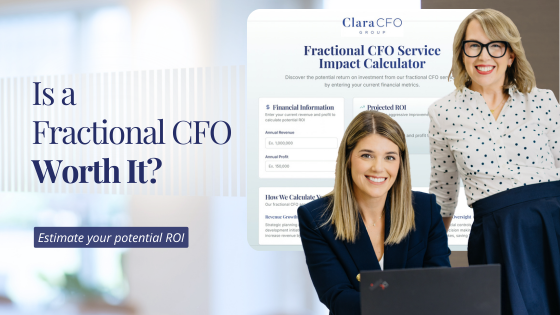
To make this easier, we built a CFO Impact Calculator. You enter your expected annual revenue and profit. It then estimates how CFO support can impact three key areas:
- Revenue improvement
- Cost optimization
- Better decision-making
The calculator gives you a range, not one guaranteed number, because every business has a different starting point and unique needs.
Think of it as a starting point for your own numbers, not a promise of a specific dollar result.

Where Does the Financial Return Come From?
Most of the financial impact shows up in three places.
Profitable
Revenue
Expense
Optimization
Better
Decisions
Helping Drive More Profitable Revenue
A fractional CFO isn’t out there selling for you. They can still help make the revenue you bring in more profitable. We usually start with:
- Pricing, including whether your rates cover the true cost of running the company
- Contract structure and payment terms
- Which clients and projects are really driving your profit
- The sales pipeline behind future revenue
Pricing
Pricing is often the first place we look.
We see many service businesses, especially those that charge by the hour, set rates that don’t reflect their actual costs. Reviewing pricing is often one of the first places we look for opportunities to improve profitability.
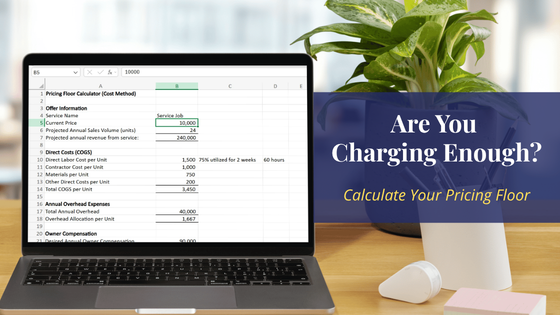
If you want to see what your pricing needs to cover, we walk through it in What Is a Pricing Floor? How to Know If You’re Charging Enough.
Contracts and Payment Terms
Contract terms matter, especially with larger clients, and timing can matter as much as the dollar amount.
A client of ours had a large contract that would have paid out a big chunk of cash right before year end, before they had time to spend it. That would have meant an unexpected tax bill. We helped them work out the timing of payments and expenses, and priced the project so it would be profitable too.
Payment terms are worth a second look for any service business. Shifting from billing after completing the work to deposits or prepayments can help cash reach you sooner.
Client Profitability and Sales Visibility
In a sales analysis, we found that 80 percent of a client’s revenue came from just five accounts. This client was spending a lot of time and energy on roughly 40 other accounts that weren’t contributing nearly as much.
Seeing that helps you decide where to focus your time and where to point your sales pipeline next. It also helps to keep a closer eye on the pipeline itself, so you can see where revenue is headed before it arrives.
Reducing and Optimizing Expenses
A thorough expense review is one of the first things we do with almost every new client.
Even when a business has reviewed its expenses before, we often find software, services, or other costs worth revisiting. Here’s where we usually look:
- Software and services that no longer earn their place
- Labor efficiency, since labor is usually the biggest expense for a service business
- Vendor terms and costs you may have treated as fixed, like your workspace
- Ideas from other businesses that have solved a similar problem
Labor is often the biggest piece. That might mean moving some roles to part time, outsourcing instead of hiring full time, or using the right tool instead of adding headcount.
A fractional CFO also draws on experience with other businesses. We have likely seen another business deal with a similar issue you have, which can help avoid starting from scratch.
Making Better Financial Decisions Before the Money Is Spent
A fractional CFO can also help before making a costly decision.
Instead of deciding based on a single sales call, we can run the decision through your Cash Flow Forecast first. Say you’re considering a $5,000-per-month marketing contract. We’d add that cost, plus a realistic timeline for when it might start bringing in revenue, to your financials before you commit. The same goes for a bigger owner draw or any other large spending decision.
Seeing the effect on your cash ahead of time turns a guess into a more informed choice.
Another set of eyes helps too:
- If you usually make decisions on your own, it helps to have someone pressure-test them before you commit.
- If you have a leadership team, an outside CFO can challenge assumptions and reduce the risk of groupthink. Teams that have worked together for years can start thinking alike without realizing it.
For more on using a forecast to guide decisions like these, see 5 Cash Flow Habits Every Healthy Service Business Practices.
The Less Quantifiable Benefits of a Fractional CFO
Some of the value of a fractional CFO won’t show up on a spreadsheet, but you’ll feel it in how the business runs.
The finance seat has an owner. Instead of the CEO or COO adding finance to an already full plate, someone whose main role is financial leadership has clear ownership of it.
Your financials are reviewed regularly. A fractional CFO works with your accounting team to make sure the numbers are reliable and ready to use. You won’t be scrambling to find months of financial history if a lender, buyer, or another opportunity appears.
You gain forward visibility. Regular forecasting means you’re looking ahead rather than only reviewing past results. You get a sense of what the next three, six, and twelve months may look like, and what needs attention before it turns into a problem.
You gain a financial thought partner. Many owners make big decisions alone. It helps to have an experienced outside voice. Someone who has seen how other businesses handled similar situations, to talk it through with.
Want to see what ongoing support looks like? Visit our fractional CFO services page.
When Is a Fractional CFO Worth It?
A fractional CFO may be worth considering when:
- Revenue is growing, but profit isn’t growing along with it
- Major financial decisions are still being made on gut instinct
- You can’t confidently predict how a new hire, investment, or contract will affect your cash position
- The CEO or COO is still carrying the finance function on top of their other responsibilities
- Your financial reports tell you what already happened, but don’t help you decide what to do next
If several of these sound familiar, try running your numbers through the CFO Impact Calculator and think about what stronger financial leadership could change.
Key Takeaways
- The ROI of a fractional CFO comes down to the value created compared to what you spend, not revenue growth alone.
- Financial impact typically comes from three areas: more profitable revenue, optimized expenses, and better financial decisions.
- Your return will depend on your own numbers and needs, so an industry wide benchmark isn’t very useful.
- Some of the most valuable parts of having a CFO, like financial leadership, accountability, and forward visibility, are harder to put a dollar figure on but still shape how the business runs.
Frequently Asked Questions
What is a fractional CFO?
A fractional CFO provides financial leadership to your business on an ongoing basis while also serving other clients. That typically includes forecasting, cash flow management, financial analysis, and support with major decisions. You can see what’s included on our fractional CFO services page.
How is a fractional CFO different from a bookkeeper or accountant?
A bookkeeper keeps your financial records accurate and current. A fractional CFO uses those numbers to help you plan, forecast, and decide what to do next. At Clara CFO Group, we provide CFO services only, and we work alongside your accounting team.
What does the CFO Impact Calculator estimate?
The calculator estimates the potential financial impact of CFO support based on the revenue and profit you enter. It provides a range rather than a guaranteed result and is designed to give you a starting point for evaluating potential ROI.
How do I get started?
If you want to explore whether fractional CFO support is a fit, you can Schedule a Discovery Call to talk through your numbers and what you’d like help with.
For more answers, visit our full FAQ page.
Estimate the Potential Impact in Your Business
A good place to start is with your own numbers.
If your company runs on EOS®, you can also read our guide on how a CFO can strengthen your EOS process to see how financial leadership fits into that operating structure.
Ready to Put a CFO in the Finance Seat?
Clara CFO Group is a boutique fractional CFO firm serving growth-stage companies generating $2M–$20M in annual revenue. We partner with CEOs who are ready to move beyond reactive financial management and install the financial leadership needed to scale with confidence.
Whether you’re running on EOS® and need a CFO who can fully own the finance function, or you’re looking for a strategic partner to guide financial planning, profitability, cash flow, and high-impact decision making, we’re here to help.
Our CFOs become an extension of your leadership team, providing the financial strategy, accountability, and insights needed to build a more profitable, scalable, and valuable business.
Schedule a Discovery Call to learn how Clara CFO Group can help you achieve your next stage of growth.