If you’ve run a business for any amount of time, you already know cash flow matters. But understanding cash flow is where things can get confusing.
One common misconception is thinking that a statement of cash flows and a cash flow forecast are basically the same thing. They both deal with cash, but they answer very different questions.
A statement of cash flows answers: Where did our cash go?
A cash flow forecast answers: Where is our cash going next?
Both are useful. But if you are trying to make better decisions about hiring, spending, debt, owner distributions, or growth, it is important to know which tool you actually need.
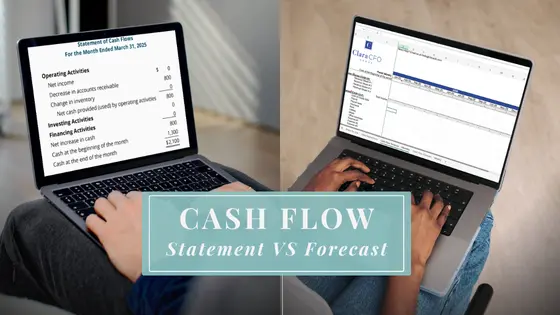
We walked through this distinction using both a statement of cash flows and a cash flow forecast spreadsheet so business owners can see how each tool works in practice.

What Is a Statement of Cash Flows?
A statement of cash flows is a formal financial report that can usually be pulled directly from your accounting software, such as QuickBooks or another bookkeeping system.
It is based on historical accounting data, which means it shows what has already happened during a specific period of time.
The statement of cash flows helps connect the dots between your profit and loss statement and your balance sheet. It usually starts with net income, then adjusts for the cash movements that did not show up neatly on the P&L.
That might include things like:
- Changes in accounts receivable
- Changes in accounts payable
- Credit card payments
- Loan payments
- Equipment or asset purchases
- Owner distributions
- Other balance sheet activity
This report can be especially helpful when your business looks profitable on paper, but your cash balance does not seem to match.
The Three Main Sections of a Statement of Cash Flows
The statement of cash flows usually breaks activity into three categories.
Operating Activities
Operating activities are tied to the normal day-to-day movement of the business. This may include changes in accounts receivable, accounts payable, credit cards, and other short-term assets or liabilities.
In simple terms, this section helps to show how regular business operations affect cash.
Investing Activities
Investing activities usually involve money spent on assets. For example, if the business buys a vehicle, equipment, or another long-term asset, that activity may show up here.
This is important because these purchases may use cash without showing up as a normal expense on the profit and loss statement.
Financing Activities
Financing activities include cash movement related to loans, debt, equity, and owner distributions.
This is where business owners often find answers when they are wondering why profit did not turn into cash. Owner draws, distributions, loan proceeds, and debt payments can all affect cash without showing up as regular operating expenses.
Why the Statement of Cash Flows Matters
The statement of cash flows helps answer one of the most common financial questions business owners ask:
“We made a profit, so where did the cash go?”
A business can show strong profit and still have less cash than expected. That cash may have gone toward paying down accounts payable, paying off a credit card, making loan payments, buying equipment, taking owner distributions, or setting aside money for taxes.
That does not necessarily mean something is wrong; it means the profit and loss statement is only one piece of the picture.
The statement of cash flows gives you another layer of visibility. It helps explain how cash moved through the business during a past period, which makes it easier to understand what really happened.
What Is a Cash Flow Forecast?
A cash flow forecast is different.
Instead of explaining the past, a cash flow forecast helps you look ahead.
A forecast usually starts with your beginning cash balance, then projects:
- Expected cash coming in
- Expected cash going out
- Other cash movements, such as debt payments or owner draws
- Estimated ending cash balance
This can be done weekly or monthly, depending on how closely you need to manage cash.
Unlike the statement of cash flows, a forecast is not a formal financial statement. It is usually built in Excel, Google Sheets, or forecasting software. It is flexible, and that flexibility is the point.
A cash flow forecast is a management tool.
Why a Cash Flow Forecast Helps You Make Better Decisions
A cash flow forecast is useful because it helps you make future-focused decisions before the cash pressure hits.
For example, a forecast can help you answer questions like:
- Can we afford to hire someone new?
- What happens if a large client payment is delayed?
- What if we skip a conference or reduce a major expense?
- When does our cash balance drop below a safe threshold?
- How much cash do we expect to have three to six months from now?
This is where forecasting becomes especially valuable for growing businesses.
You are not just looking at what happened. You are testing what could happen.
If payroll increases, what happens to cash? If revenue is delayed by a month, does the business still have enough cushion? If you want cash to stay above a certain minimum, when do you need to adjust spending or collections?
That is the kind of visibility business owners need when they are trying to grow without constantly reacting.
Cash Flow Statement vs. Cash Flow Forecast
Here is the simplest way to think about the difference.
|
Tool |
Looks At | Purpose | Format | Best Used For |
| Statement of Cash Flows | The past | Explaining how cash moved | Formal financial statement | Understanding where cash went |
| Cash Flow Forecast | The future | Planning and decision-making | Flexible management tool | Deciding what the business can afford next |
The statement of cash flows is historical. It tells you what already happened.
The cash flow forecast is forward-looking. It helps you plan for what may happen next.
One is more formal. One is more flexible.
One is built from actual accounting activity. One is built from assumptions, plans, and expected timing.
Both matter, but they serve different roles.
When Someone Asks for a Cash Flow Report
If a bank or lender asks for a cash flow report, they are usually asking for a statement of cash flows.
That is because they typically want to see historical, actual financial activity. They may ask for your profit and loss statement, balance sheet, and statement of cash flows so they can understand how cash has moved through the business.
A cash flow forecast may be helpful in other planning conversations, but it is usually not the report they are asking for.
Do You Need Both?
Yes, most growing businesses benefit from both.
The statement of cash flows helps you understand what happened in the past. It can show why profit and cash did not match and where cash actually moved.
The cash flow forecast helps you look ahead. It gives you a way to plan for hiring, owner pay, debt payments, taxes, large expenses, and future growth decisions.
Together, they give you a much clearer picture of your cash.
One helps you explain.
The other helps you decide.
Key Takeaways
- A statement of cash flows explains past cash movement.
- A cash flow forecast helps you plan future cash movement.
- Profit and cash are not the same thing.
- Owner draws, debt payments, taxes, and balance sheet activity can explain where cash went.
- A cash flow forecast is one of the most useful tools for making better hiring, spending, and growth decisions.
Want a Simple Way to Start Forecasting Cash?
If you are ready to get more visibility into your future cash position, download our free cash flow forecast template.
You can use it to map out your expected cash in, cash out, and ending cash balance so you can start making more confident financial decisions.
Download the FREE Cash Flow Forecast Template
Ready to Put a CFO in the Finance Seat?
Clara CFO Group is a boutique fractional CFO firm serving growth-stage companies generating $2M–$20M in annual revenue. We partner with CEOs who are ready to move beyond reactive financial management and install the financial leadership needed to scale with confidence.
Whether you’re running on EOS® and need a CFO who can fully own the finance function, or you’re looking for a strategic partner to guide financial planning, profitability, cash flow, and high-impact decision making, we’re here to help.
Our CFOs become an extension of your leadership team, providing the financial strategy, accountability, and insights needed to build a more profitable, scalable, and valuable business.
Schedule a Discovery Call to learn how Clara CFO Group can help you achieve your next stage of growth.